
Introduction: ECG interpretations are often misdiagnosed, and electrocardiographic emergencies are frequently missed, leading to adverse patient outcomes. Currently, many medical education programs in residency lack an organized curriculum and competency assessment to ensure trainees master this essential skill. In real clinical practice, it is paramount for the residents to utilize bedside tools to identify disease and its progression accurately. Such a tool is an electrocardiogram and its correct interpretation by residents. The interpretation of ECG requires an adequate and proper understanding of cardiac anatomy and pathophysiology. When it comes to the bedside, the residents must visually recognize interpretations and use diagnostic reasoning. It has been recorded and published in numerous articles that evidence regarding the optimal techniques for identifying EKG interpretations is lacking in medical education. A recent meta-analysis in JAMA Internal Medicine showed that, across training levels, median accuracy for ECG interpretation was just 54% on pretraining assessments and 67% on post-training assessments. Performance on pretraining assessments was lowest among medical students (42.0%), increasing to 55.8% for residents, 68.5% for practicing physicians, and 74.9% for cardiologists. Patients coming to a teaching hospital have an expectation that faculty and trainees will provide a higher level of patient care in a community hospital setting. Our project goal was to improve this deficiency in education for all our residents. LCH has recognized this gap in medical education and can improve patient outcomes by providing a hands-on EKG curriculum for residents. The purpose of this research project was to develop an EKG curriculum module to enhance this core skill in EKG reading and interpretation for residents training in the Larkin Hospital system. By providing this training competency will be increased, patient outcomes will improve and the potential for medical errors should be reduced.
Method: The goal of this research project was to improve educational deficiencies in ECG interpretation by residents in a community hospital setting within a 12-month period. To achieve the goal, the project was implemented in three phases with specific objectives for each phase. In Phase I materials to implement the project were developed which included the development of the pre-post survey, the purchase of EKG equipment and materials and development of a resident recruitment flyer. In Phase II participants for the project were recruited, and the EKG curriculum was developed and implemented. The bedside clinical cases were designed to be active interpretation and discussion aligning with the Kern Model to include the areas of: Cardiac axis identification, Rhythm identification with blocks, Abnormal RR progression and its interpretation, Myocardial infarction, Ischemia and strain pattern with overall clinical interpretations of the disease finalizing the curriculum. The population for the study included male/female, PGY 1-2 Internal medicine residents from a community hospital. Following the pre-test survey, EKG study materials were provided participants in preparation for the active clinical case discussion. The immersive 12-hour EKG curriculum included assessment, online study, and case discussion. Phase III of the project included data collection from the participants from the pre-post survey, statistical analysis of the outcomes and dissemination of the project findings. We hypothesized that a focused, case-based EKG teaching intervention would improve and bridge the gap between theoretical knowledge and clinical competency. We expected that objective knowledge could show incremental gains, while resident’s self-evaluated clinical readiness competency would exhibit a significant shift across the Miller’s Pyramid professional scale. The findings of the data analysis are detailed in the following section.
Data Analysis: The data analysis of this project examined two major areas concerning resident improvement: increase in objective knowledge and an increase in clinical competency.
Knowledge Assessment Overview: The knowledge assessment section examined changes in objective EKG knowledge, after course participation. Knowledge was evaluated using standardized pre- and post-tests which contained ten questions, with each response scored as correct or incorrect. The main outcome is the total knowledge score (range: 0–10), evaluated in a paired format for each participant.
Knowledge Score Analysis
Descriptive statistics were applied primarily to summarize a preliminary overview of overall group performance prior to, and following the training, without making inferential claims.
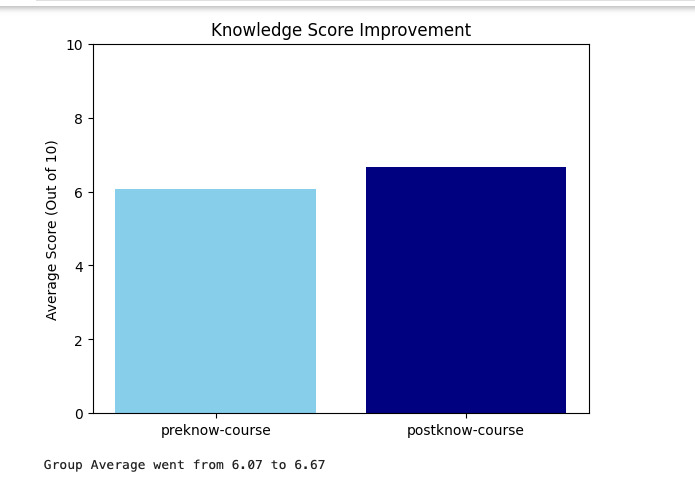
Pre-course mean knowledge score: 6.07 / 10
Post-course mean knowledge score: 6.67 / 10
Mean change: +0.60 points (≈ 6% absolute improvement)
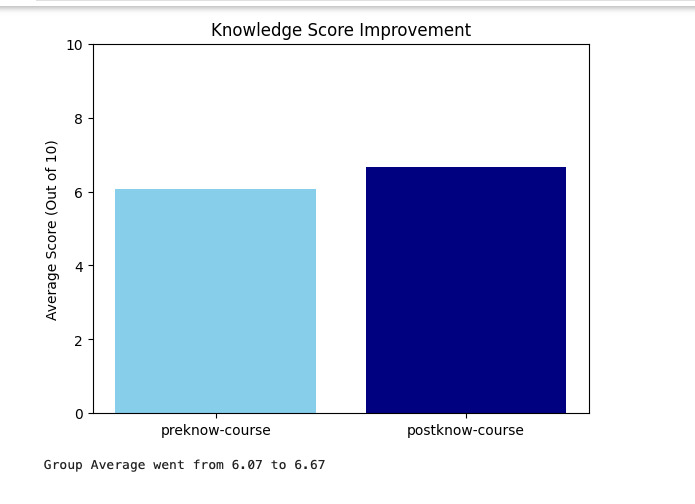
Interpretation: At the group level, knowledge scores showed a minor increase in post training (Fig1), indicating a positive directional trend. However, the scope of change appears limited and requires further investigation at the individual level.
Paired Hypothesis Testing
To evaluate whether the observed shift in knowledge scores is above what would be expected in random, a paired hypothesis test was conducted using a t-test.
Null Hypothesis (H₀)
There is no statistically significant variance in the mean scores of participants between the pre-test and post-test, any variation is random.
Alternative Hypothesis (H₁)
Post-test scores for both knowledge and competency are significantly higher than pre-test scores; the training was effective.
Results: P-value: 0.2462
Interpretation: Using a standard significance threshold (α = 0.05), the observed improvement in knowledge scores was not statistically significant. Therefore, the null hypothesis cannot be rejected. The observed increase could consequently be due to random variation rather than a definitive effect of the training.
Effect Size and Uncertainty
Cohen’s d was used to evaluate the extent of the observed change independently of statistical significance.
Result: Cohen’s d = 0.36
Interpretation: This value indicates a small-to-moderate effect size, implying that the level of improvement, while not statistically significant, is educationally meaningful.
Confidence Interval for Mean Knowledge Change
A 95% confidence interval was calculated to better understand the uncertainty surrounding the mean change in knowledge.
Result: 95% Confidence Interval: −0.46 to +1.66
Interpretation: We are 95% confident that the real average knowledge change falls between a minor decrease, and a modest improvement. Because this interval includes zero, the data do not definitively demonstrate a causal effect of the training on knowledge scores.
The summary results on resident knowledge indicated: average knowledge scores exhibited a little rise following the course, individual responses were heterogeneous, with clear gainers, many stable participants with few declines, the paired t-test did not detect a statistically significant mean difference, and effect size estimates suggest a small-to-moderate educational impact, but confidence intervals indicate substantial uncertainty. Overall, the knowledge analysis suggests a positive but inconclusive trend toward improvement.
Competency Assessment Overview
This section analyses changes in clinical competency in EKG interpretation after the participation in the training course. Competency was evaluated using a self-evaluation based on the Dreyfus model of skill acquisition, which classifies professional development across five ordered stages: Novice (N), Advanced Beginner (AB), Competent (C), Proficient (P), and Expert (E). Each participant took the same competency assessment before and after the course, enabling a paired comparison of individual competency levels. Responses were treated as ordinal categorical data, reflecting progression in professional judgment and performance rather than numeric scores. Therefore, analyses preserved the structured integrity of the Dreyfus framework and avoided assumptions of uniform intervals between competency levels. The competency assessment was analyzed using a combination of descriptive, paired, and inferential methods suitable for ordinal data to delineate distributional changes, individual progression, and overall shifts in competency post the training.
Competency Descriptive Analysis
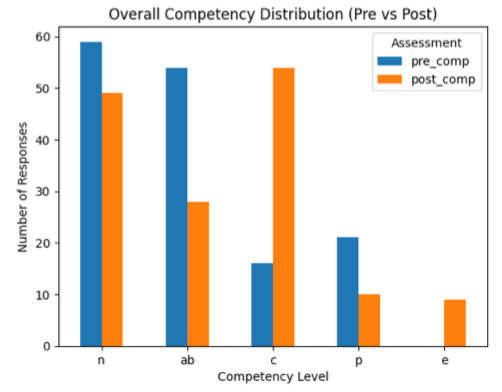
To first understand how competency changed at the group level, overall distributions of Dreyfus competency levels were analyzed before and after the course. This descriptive analysis offers a preliminary, non-inferential evaluation of whether competency shifted in the anticipated direction following training.
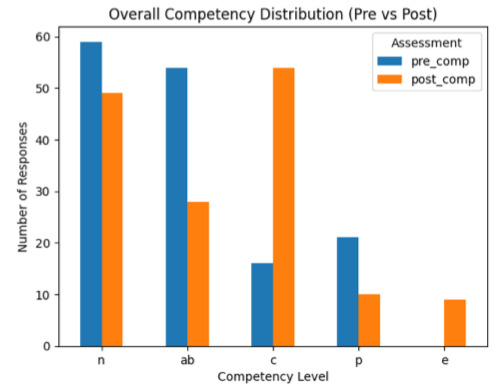
Results: At baseline, competency evaluations were predominantly located in the Novice and Advanced Beginner categories. Following the course, the post-training distribution showed a visible shift toward the competent category and a corresponding reduction in lower-level classifications.
Interpretation: These descriptive trends suggest a visible upward shift in competency following the course. The post-training distribution suggests movement away from early developmental stages toward the competency level of clinical competence, supporting a positive directional effect of the training at the group level.
Question-Level Competency Patterns
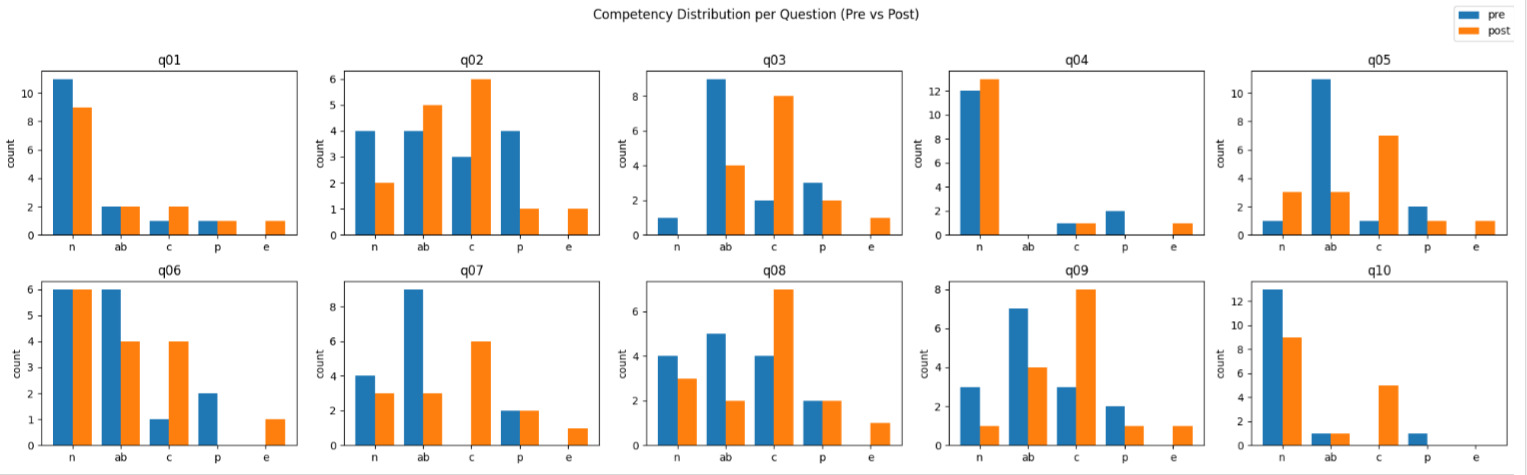
To gain a better understanding of how particular competencies responded to the training, competency distributions were analyzed individually for each assessment question. This analysis supports educational interpretation by identifying areas of improvement, ceiling effects, and persistent gaps.
Results: Several competency items demonstrated clear post-training shifts toward higher Dreyfus levels, indicating responsiveness to the instructional intervention. Other items showed high baseline competency with minimal post-course change, consistent with ceiling effects. A small number of competencies remained concentrated in lower levels, suggesting areas where additional instructional emphasis may be required.
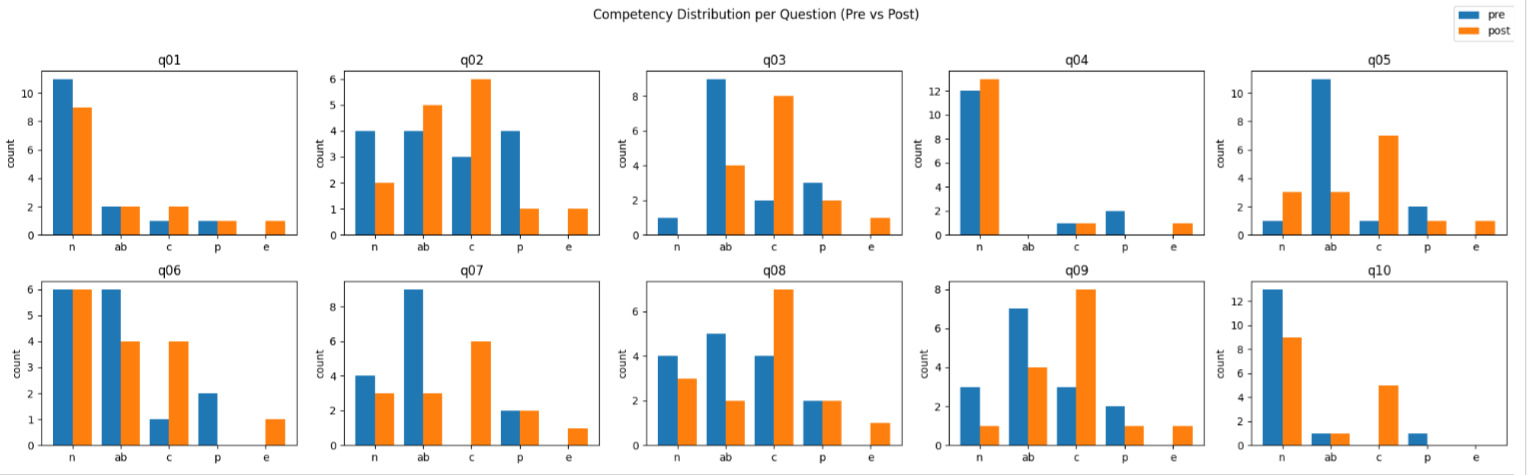
Interpretation
The question-level patterns indicate that observed competency gains were inconsistent across all areas. Although many competencies improved substantially, others were already strong or remained challenging. These findings require further investigation of paired changes at the individual level to determine whether participants themselves progressed along the competency continuum.
Paired Direction-of-Change Analysis
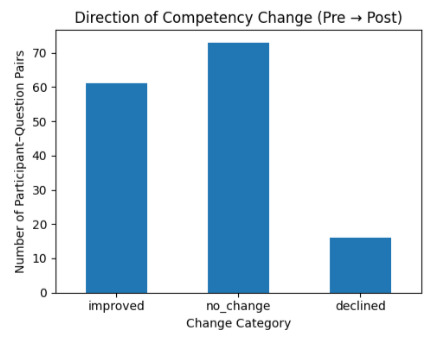
A paired direction-of-change analysis was conducted to evaluate whether individual participants showed meaningful progress. For each participant–question pair, changes were classified as Improved, No Change, or Declined, preserving the ordinal nature of the Dreyfus framework (Fig6).
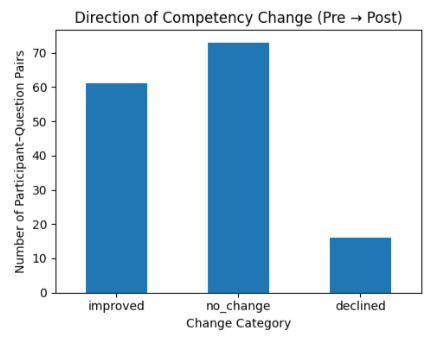
Results: Most paired observations either showed improvement or no change, with relatively few instances of decline. Improvements outnumbered declines, and stability was prevalent among participants who began at higher competency levels.
Interpretation: These findings suggest that upward movement along the competency scale prevalent, while regression was low. However, direction-of-change summaries do not show the full structure of transitions between competency levels. A transition analysis was performed to visualize where movement occurred across the Dreyfus categories.
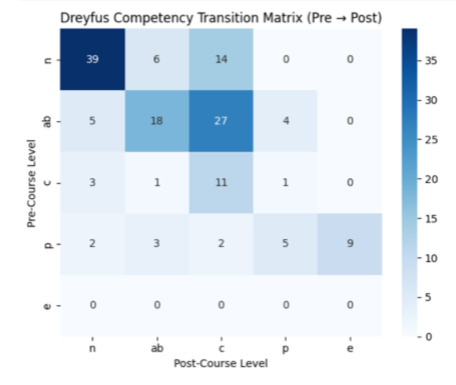
Competency Transition Patterns: To visualize detailed movement between pre- and post-training competency levels, a transition matrix was constructed mapping pre-to post- training classifications.
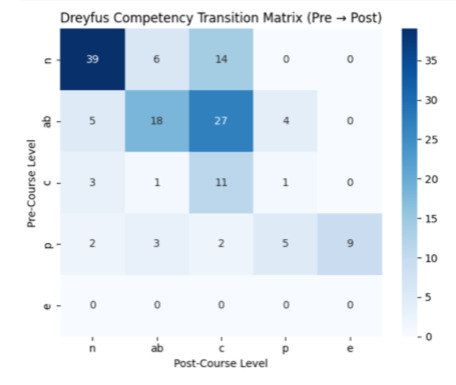
Results: Transitions were primarily upward, especially from Novice and Advanced Beginner to Competent level. Diagonal cells indicated expected stability among participants already reporting higher competency levels.
Interpretation: The transition patterns visually reinforce the predominance of upward movement and minimal regression. An ordinal paired hypothesis test was performed to assess whether the observed distributional changes exceeded what would be expected by chance.
Formal Hypothesis Testing of Competency Change
A marginal homogeneity test (Stuart–Maxwell framework) was used to statistically evaluate whether competency distributions differed between pre- and post-training assessments. This test is appropriate for paired, multicategory, ordinal outcomes and does not assume numeric spacing between competency levels.
Results: The test shows a statistically significant difference between pre- and post-training competency distributions (χ²(4) = 36.90, p < 0.001).
Interpretation: This result offers strong statistical evidence that the observed competency shifts are unlikely to be attributable to mere chance, confirming a significant overall change in competency following training. To contextualize these findings relative to expected trainee performance, a benchmark-based interpretation was next applied.
Benchmark-Based Interpretation of Competency
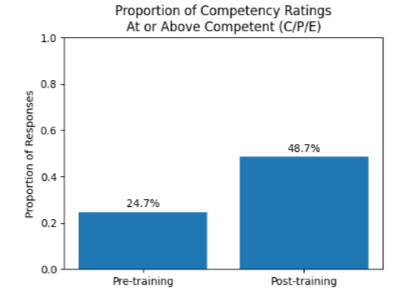
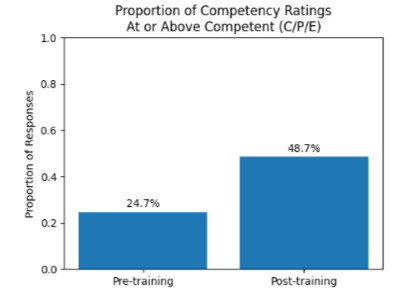
Because most participants were early-stage trainees, competency outcomes were further assessed using a practical benchmark. Competency ratings were classified as below Competent (Novice or Advanced Beginner) or at or above Competent (Competent, Proficient, or Expert), reflecting a minimum expected level of independent clinical performance (fig; 8).
Results
The proportion of ratings at or above the Competent level increased from roughly 25% pre-training to nearly 50% post-training. A paired McNemar test confirmed that this increase was statistically significant (p < 0.001), with substantially more observations crossing into the benchmark category than falling below it.
Interpretation
These findings indicate that the training not only shifted competency distributions overall but also meaningfully increased the proportion of assessments meeting or exceeding an expected competency threshold. Stability among higher-level participants further suggests consolidation of appropriate competency rather than stagnation.
The summary results on resident clinical competency changes indicated: Question-level analyses identified both training-responsive competencies and areas of ongoing challenge, paired analyses showed that upward progress predominated and regression was rare, formal testing confirmed a statistically significant change in competency distributions, and benchmark-based interpretation demonstrated a substantial increase in ratings meeting or exceeding expected competency levels. These findings provide consistent and converging evidence that the training was associated with meaningful improvements in clinical competency.
Discussion
The project hypothesis was that a case-based EKG teaching intervention would improve the gap between theoretical knowledge and clinical competency among residents. We thought that knowledge could show incremental gains, and that residents’ self-evaluated clinical readiness competency would increase. The findings from the data collection and analysis showed that knowledge had a positive but inconclusive trend toward improvement, while competency findings provided evidence that training was associated with meaningful improvements in clinical competency. Based upon data collection and statistical analysis, our recommendation is to continue to implement the EKG project to obtain a larger sample size to address generalizability going forward. We would also like to recommend duplication of this project to other residency programs as well as programs at other sponsoring institutions.
Conclusion
In reflection, two successes stand out; first, interactive bedside clinical cases, was used at Larkin Community Hospital for resident education. To observe the participation and team discussion of patients amongst each other, was heartfelt as we watched the concept of life-long learning amongst physician colleagues. Second, was the implementation of the Dreyfus Model for Clinical Assessment to measure progress of the residents’ learning and application of knowledge? Competency education has been promoted to achieve the resident milestones of the ACGME, however for community physicians using a true competency assessment model was something challenging and underutilized. Using the Dreyfus Competency Model allowed us to demonstrate how it could be adapted and used to assess knowledge. Seeing how the model measured competency level of individual learners as well as the aggregate data on the cohort really impacted the value and usefulness of this assessment tool. LCH would like to do further research on this educational model and assessment tool to determine if this educational method has a correlation to improving learning enough to influence licensing exam scores of residents.
Acknowledgements
Larkin Community Hospital would like to acknowledge Lake Erie College of Medicine (LECOM), and the LECOM Consortium Academic Excellence (LCAE) for their funding support for this grant initiative. We would also like to give a special note of appreciation to the LCH Internal Medicine Residency program and the leadership of Dr. George Michel and Dr. Sohair Angly for their participation