
INTRODUCTION
The most prevalent cause of infection among elderly populations who are hospitalized or receiving long-term care is urinary tract infections (UTIs), which rank second among infections among these elderly populations who live in the community.1 Elderly individuals who have UTIs are more vulnerable to developing sepsis if they are bedridden, frail, or require assistance with everyday activities. New onset seizures are common in older adults, around 50% of the cases occur in the geriatric age.2,3 New onset seizures are attributed to seizures that occur during acute systemic illness or secondary to new brain injury.4 Febrile seizures are usually generalized and have a duration of less than fifteen minutes with no recurrence within 24 hours. While, the presence of focal seizures appearance, duration of >15 minutes, and frequency of multiple seizures within 24 hours are among the diagnostic criteria for complex febrile seizures.5
In older adults with cognitive impairment urinary tract infections (UTIS) symptoms are difficult to elicit; in such cases, clinical suspicion of UTIs depends on evolution of new symptoms.5 In 2020, Naveed’s study showed that one patient documented to have a new onset seizure secondary to UTI.6
To bring notice to such clinical presentations, we report a case of new onset seizure in an Octogenarian female with no other significant past medical history apart from thoracic spinal stenosis, hyperlipidemia, dementia, type 2 diabetes mellitus, intellectual disability, hearing impairment and hypertension. This case report highlights the importance of having a high index of suspicion regardless of symptomatology to prompt early recognition of UTIs as a first cause for new onset seizure in an elderly population.
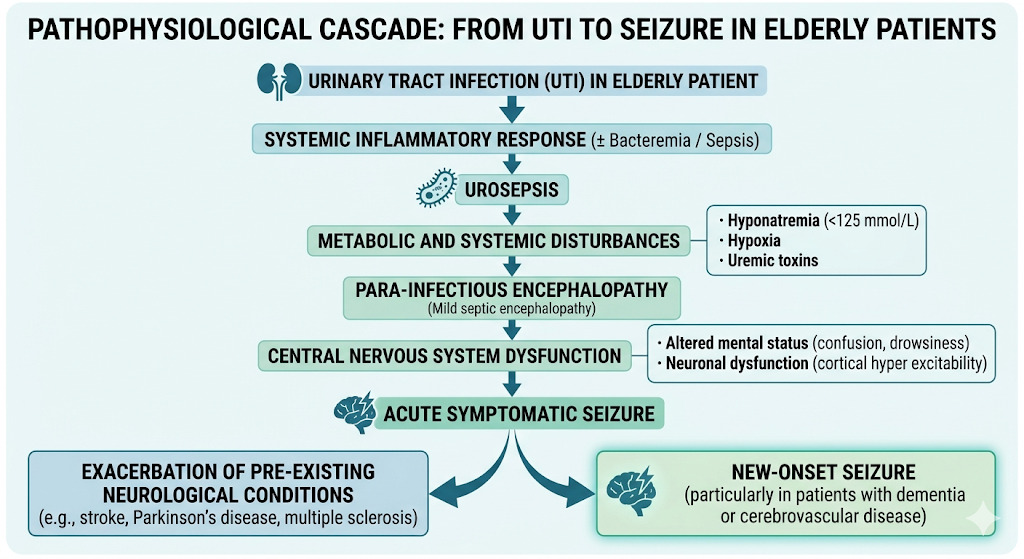
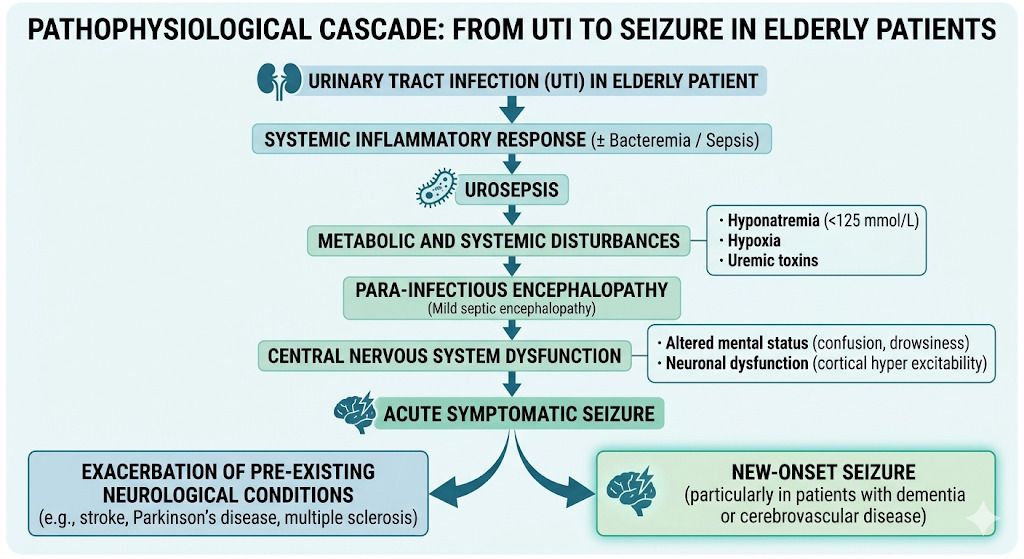
Figure 1 below shows key pathophysiological mechanisms of new onset seizure secondary to UTI.
CASE DESCRIPTION
An 80-year-old woman with a medical history of thoracic spinal stenosis, hyperlipidemia, dementia, type 2 diabetes mellitus, intellectual disability, hearing impairment and hypertension who presented to the emergency room with a witnessed new onset seizure. A family friend who lives with the patient reported, the episode was described as whole body shaking and foaming at the mouth with post ictal phase. Unknown duration and unsure if eyes were open or not. Per family, the patient had never experienced a seizure before. The patient with intellectual disability on baseline, cannot write, read, has minimal verbal communication, hearing impairment, and ambulates with walker at home, able to feed herself with incontinent bowel and bladder. The patient did not have any fever, cough, shortness of breath, diarrhea, nausea, or vomiting. The patient had never been a smoker or a drinker.
The vital signs on admission were body temperature 36.4 C, heart rate 69 beats per minute, respiratory rate 17 breaths per minute and O2 saturation 97% on room air, and blood pressure 142/74 mmHg. The physical examination was unremarkable, including a neurological examination which showed she is alert and oriented to self only, following commands, no focal deficit and with intact sensations. Laboratory workup was significant for the following glucose 217 mg/dl, urea 39 mg/dl, creatinine 1.79 mg/dl, GFR 27 ml/min/1.73, alkaline phosphatase 133 U/L (reference range 38-126 U/L), alanine transaminase 58 U/L (reference range 0 – 35 U/L), Hbg 11.6 g/dl, BNP 734 pg/ml, and Lactic acid 1.60 mmol/L. Urinalysis was for positive bacteria, and leukocyte esterase. Electrocardiogram showed sinus arrhythmia with one supraventricular premature beat. Minor nonspecific ST-T wave changes are more pronounced over the high lateral leads. Imaging studies, chest x ray and CT brain, were within normal findings.
The patient was admitted for further work up and symptomatic treatment under diagnosis of new onset seizure of unknown cause. Levetiracetam 500 mg IV twice daily was started, EEG ordered, and a neurology team was consulted. On hospital day 2, the patient was somnolent and arousable but not at her baseline according to her sister. She was able to answer questions and follow simple commands. Urine culture came back positive for gram negative bacilli, with antibiotic sensitivity pending. The patient started on empiric antibiotics Ceftriaxone 1gm intravenous (IV) daily. Neurology team recommended to hold antiepileptic drugs since this was a new onset seizure episode and to proceed with electroencephalography (EEG) and magnetic resonance imaging (MRI) brain with and without contrast. On hospital day 3, the patient was somnolent but more alert, arousable and was only able to follow simple commands. Urine culture came back positive for E. coli extended-spectrum beta-lactamases (ESBLs) that were only sensitive to Meropenem. The infectious disease team was consulted and recommended to switch Ceftriaxone to Meropenem 1 gm IV twice daily for 7 days. The neurology team considered this new onset seizure secondary to UTIs due to E. coli extended- spectrum beta-lactamases (ESBLs). They recommended canceling EEG and MRI brain. The patient had completed Meropenem course in the hospital and her kidney functions had improved from admission with urea 20 mg/dl, creatinine 1.16mg/dl, GFR 45 ml/min/1.73. The remainder of the hospital course was uneventful. She was discharged home in good condition without any other seizure events during her hospitalization.
DISCUSSION
Urinary tract infections (UTIs) are common in the elderly. The clinical presentation can range from no symptoms (asymptomatic bacteriuria) to urosepsis. There are many risk factors for symptomatic urinary tract infections such as immune-senescence, multiple comorbidities, history of urinary tract infections, and exposure to nosocomial pathogens.7,8 Older adults may present with non-specific symptoms such as delirium, fatigue, decline in functional status and other symptoms.
New onset seizures are common in older adults, with approximately 50% of cases secondary to acute stroke either hemorrhagic or ischemic but rarely with transient ischemic attacks; 6-30% are secondary to metabolic encephalopathy due to hypoglycemia, hyperglycemia, hyponatremia, uremic or hepatic encephalopathy; 10% are due to drugs and alcohol withdrawals, and 5-20% are secondary to other causes such as trauma or infections.9,10 In this case the patient presented with a new onset seizure and her lab work was significant for UTI secondary to E. coli extended-spectrum beta-lactamases (ESBLs). In older adults, we must pay attention to the nonspecific symptoms of urinary tract infections such as new onset seizures, confusion, behavioral change, fatigue, and others.
Diagnosing seizure as initial presentation secondary to UTIs can be a challenging clinical dilemma in an aging population due to several confounding variables pertaining to the patient’s comorbidities, care provider bias, and the results of labs and imaging. Both under diagnosis and over diagnosis are frequent. Comorbidities, cognitive impairments, aging-related physiological changes, and pharmacological interactions all make treatment more challenging.
Our case highlights how challenging it can be to diagnose UTIs in elderly patients because they may exhibit unusual symptoms including the initial presentation of seizures. Elderly patients should receive empirical treatment based on clinical evaluation, and urinalysis as soon as possible to avoid progression of the disease and development of serious complications.
CONCLUSION
In summary, elderly patients with urinary tract infections could present with new onset seizures. A multifaceted approach to managing such initial presentation includes comprehensive medication reviews, shared decision making, and close interprofessional communication and collaboration between multidisciplinary care management teams. Although this presentation may not be common, it is important to maintain awareness of its potential and include evaluation for this possibility early in the patient assessment to ensure optimal patient outcomes.
Conflict of Interest
All the authors declare no conflicts of interest associated with this research.
Funding
This research received no specific grant from any funding agency in the public, commercial, or not-for-profit sectors.